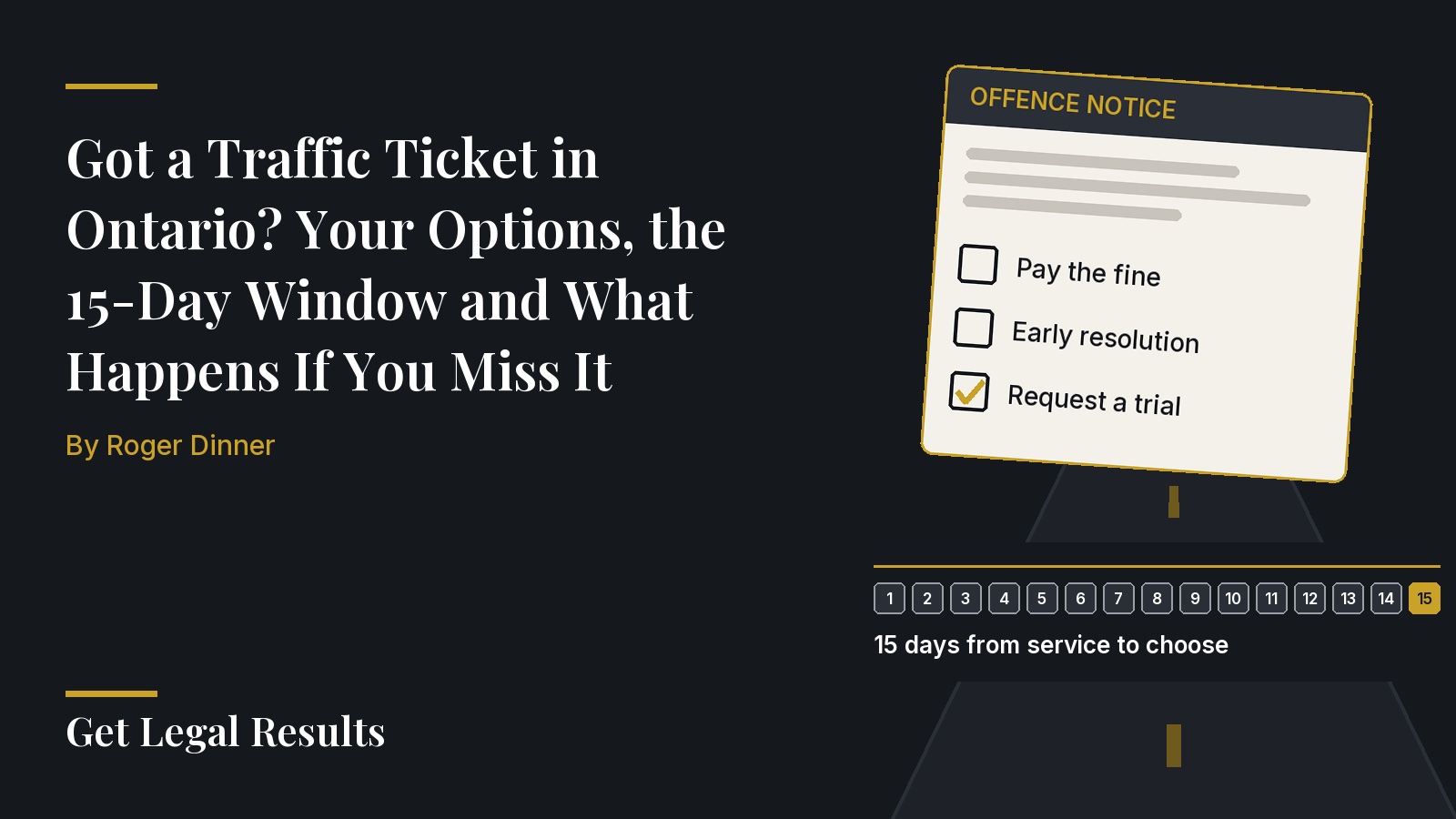
A police officer hands you a ticket at the side of the road, and it goes into the glove box. A week later you find it again and wonder what you are supposed to do with it. The answer matters more than most people think. Your Ontario traffic ticket options are printed on the back of that piece of paper, and the law gives you a short window to choose one. If you choose nothing, the court can choose for you.
This article walks through each option, what it actually means in law, the 15-day window, and what happens if you miss it. It is written for drivers in Ontario who have received an offence notice (the usual roadside ticket) for a Highway Traffic Act charge such as speeding, a stop sign or a hand-held phone. It does not cover a summons, which is a different document with different rules, criminal driving charges, parking tickets, or notices from automated speed or red light cameras, which follow their own service and procedure rules.
Everything below comes from the Provincial Offences Act, R.S.O. 1990, c. P.33 (Part I is the part that governs tickets), the Ontario Court of Justice's Guide for Defendants in Provincial Offences Cases, and the Ontario government's page on checking traffic tickets and requesting a meeting online. Section numbers are given so you can check them yourself.
What an Ontario traffic ticket actually is
The ticket is called an offence notice. It starts a proceeding under Part I of the Provincial Offences Act. The officer also completes a certificate of offence, which is the version the court office keeps. The Act says the offence notice or summons must be served personally on the person charged within thirty days after the alleged offence (s. 3(3)), and the certificate of offence must be filed with the court office no later than seven days after service (s. 4).
Two things on the ticket matter most right away. The first is the set fine and the total payable, which is what you would pay if you simply paid. The second is the court office named on the notice. That office is where your choice has to go. Under the Act, a notice of intention to appear is not valid unless it is received by the court office specified on the offence notice (s. 5(4)), and the same rule applies to a request for an early resolution meeting (s. 5.1(2.1)). If you are not sure where that office is, our directory of Ontario provincial offences courts lists every POA court in the province with its address and contact details.
The Ontario Court of Justice guide explains that there are two types of offence notices. On one type, the options are pay, plead guilty with an explanation, or ask for a trial. On the other type, the middle option is replaced by a request for a meeting with the prosecutor. Read the back of your own ticket before you decide anything. It tells you which options you have and how to deliver your choice.
Your Ontario traffic ticket options, one by one
Depending on the ticket and the court, you will have three or four choices. Here is what each one means.
Option 1: Pay the fine
Paying sounds like the end of the matter, and in one sense it is. But the law is clear about what payment means. Under section 8(2) of the Act, the court office's acceptance of your payment is a plea of guilty, a conviction for the offence, and the imposition of the set fine. In plain terms, paying is pleading guilty. Whatever consequences follow a conviction for that offence, such as demerit points, follow a payment too.
That is not a reason never to pay. For some people and some charges, paying is a sensible choice. It is a reason to pay knowing what you are agreeing to, rather than to make the paper go away.
Option 2: Plead guilty with an explanation
Section 7 lets a defendant who does not want to dispute the charge, but wants to make submissions about the penalty, appear before a justice to plead guilty and explain. The justice can impose the set fine or a lesser fine permitted by law, and you can ask for more time to pay. The justice may require your submissions to be made under oath.
Note the limit in the wording. Section 7 applies to a defendant who does not have the option of meeting with the prosecutor under section 5.1. If your ticket offers an early resolution meeting, that is usually the route for discussing penalty instead. The Ontario government's page describes this option as available only where it appears on your ticket.
Option 3: Request an early resolution meeting
Where the offence notice says the option is available, section 5.1 lets you ask for a meeting with the prosecutor to discuss resolving the charge. You make the request on the offence notice and deliver it to the court office, or in any other manner the notice specifies, within 15 days after you were served (s. 5.1(2)). Many court offices now take this request through the province's online system, which the Ontario government page links to.
Once you ask, the clerk sends you notice of the meeting's time and place. A few practical points come straight from the Act:
- If the time does not suit you, you may deliver one written request to reschedule, at least two days before the meeting, and the clerk must arrange a new time within 30 days of the original one (s. 5.1(4)).
- The meeting can take place by electronic method (s. 5.1(6)). The City of Toronto, for example, says its early resolution meetings are generally held by telephone.
- At the meeting, you and the prosecutor may agree that you will plead guilty to the offence or to a substituted offence, and make submissions on penalty, including more time to pay (s. 5.1(7)).
- If you agree, you then appear before a justice to enter the plea, and the justice may enter a conviction and impose the set fine or another fine permitted by law (s. 5.1(8) and (9)).
- If you do not reach an agreement, or the justice does not accept the guilty plea, the clerk sends notice of a trial date (s. 5.1(11)).
The Ontario Court of Justice guide puts the most important point plainly: by meeting with the prosecutor, you do not give up your right to a trial. The guide also says possible resolutions could include a withdrawal of the charge or an agreement to plead guilty to a less serious charge. Neither is promised. What the prosecutor offers depends on the charge, the evidence and the prosecutor's own view of the case.
Option 4: Request a trial
Section 5 lets you give notice that you intend to appear in court to enter a plea and have a trial. You can do it by completing the notice of intention to appear part of the offence notice and delivering it to the court office as the notice describes, by using the regulated form, or in any other manner the offence notice specifies (s. 5(1)). The Ontario government page says you can request a trial online where that service is available, or contact the court office directly where it is not.
Once the court office receives your notice, the clerk must give you and the prosecutor notice of the time and place of the trial (s. 5(5)). The clerk may reschedule the trial for administrative reasons by sending a revised notice within 21 days (s. 5(6)).
Asking for a trial is not the same as winning one, and it is not a commitment to fight to the end. It keeps every option open. You can still discuss resolution with the prosecutor before the trial date, and you can still plead guilty if you decide to.
The 15-day window, and what "deemed not to dispute" means
Here is the part people miss. Section 9(1)(a) of the Act says a defendant is deemed not to wish to dispute the charge if at least 15 days have passed since the offence notice was served and the defendant has not given notice of intention to appear, has not requested an early resolution meeting, and has not pleaded guilty under section 7 or 8.
"Deemed not to dispute" is a legal way of saying the court will treat you as if you accepted the charge. Under section 9(2), the clerk of the court then examines the certificate of offence. If it is not defective, the clerk enters a conviction in your absence, without a hearing, and imposes the set fine. If it is defective, as the regulations define that, the clerk quashes the proceeding.
So the default outcome of doing nothing is usually a conviction. You will not be in the room, nobody will hear your side, and the conviction carries the same consequences as if you had paid.
Counting starts from service, which for a roadside ticket is normally the day the officer handed it to you. The Ontario Court of Justice guide describes the same rule in everyday terms: if you get a ticket and do not choose one of your options within 15 days of receiving it, you may be found guilty. The practical advice is simple. Decide within the first few days, deliver your choice to the right court office in the way the notice describes, and keep proof that you did.
Two other situations also lead to a deemed conviction. Under section 9(1)(b), if you asked for an early resolution meeting and then did not attend it, you are deemed not to dispute the charge. Under section 9(1)(c), if you reached an agreement with the prosecutor but did not appear before the justice afterwards, the same applies. And under section 9.1, if you were given notice of a trial and did not appear, a justice examines the certificate of offence and enters a conviction in your absence if the certificate is complete and regular on its face. If the justice cannot enter a conviction, the proceeding is quashed.
Missed the deadline or the court date? Your reopening options
If a conviction has already been entered without a hearing, there are two routes back in. Both have their own 15-day limits.
Reopening under section 11. A defendant convicted without a hearing may, within 15 days after becoming aware of the conviction, apply to have it struck out by completing the prescribed form and filing it at the court office (s. 11(1)). The clerk must strike out the conviction if satisfied, by your affidavit or other evidence, that through no fault of your own you were unable to attend the early resolution meeting, were unable to appear for a hearing, or did not receive a notice or document about the offence (s. 11(2)). If the clerk does not strike it out, the application goes to a justice for review (s. 11(3)). The Ontario Court of Justice guide names the forms as Form 102 or 102.1, the Reopening Application/Affidavit. If the conviction is struck out, the clerk gives notice of a new meeting, appearance or trial date (s. 11(4)).
The key words are "through no fault of the defendant." Forgetting the ticket in the glove box is unlikely to fit. A notice that never reached you, or a hospital stay on the trial date, is the kind of situation the section describes. You will be swearing an affidavit, so it must be accurate.
Striking out under section 9(3) for a defective certificate. If you were convicted by the clerk after the 15 days ran out or after missing an early resolution meeting, section 9(3) lets you apply to a justice, within 15 days after becoming aware of the conviction, to strike it out. Under section 9(4), the justice must strike it out if satisfied the certificate of offence is defective, as determined by the regulations, or is otherwise not complete and regular on its face. This route is about the paperwork, not about why you missed the deadline.
There is also an appeal. Section 135 of the Act lets a defendant appeal a conviction or sentence in a Part I proceeding to the Ontario Court of Justice presided over by a provincial judge. The notice of appeal must be filed with the clerk within 30 days after the decision (s. 135(2)), and the appeal is conducted by means of a review (s. 136(2)). An appeal is a more formal step than reopening, and it is worth getting advice before you start one.
What a conviction can cost beyond the fine
The set fine is the number on the ticket. It is often not the number that matters most. Many Highway Traffic Act convictions add demerit points to your driving record. The Ontario government's page on understanding demerit points, together with the regulation behind it, O. Reg. 339/94, sets out how they work. According to that page:
- Demerit points stay on your record for two years from the offence date.
- Exceeding the speed limit by 16 to 29 km/h adds 3 points, and by 30 to 49 km/h adds 4 points. Exceeding it by 50 km/h or more, or by 40 km/h or more where the limit is under 80 km/h, adds 6 points.
- Careless driving adds 6 points. Driving while holding or using a hand-held device adds 3.
- A fully licensed driver who reaches 15 or more points faces a 30-day licence suspension. A novice driver (G1, G2, M1, M2 and similar classes) who reaches 9 or more faces a 60-day suspension. Warning letters come earlier on both scales.
Some charges carry other consequences under the Highway Traffic Act itself, which are outside the scope of this article. Insurance is the other cost people worry about. How a conviction affects your premium depends on your insurer and your policy, so ask your broker rather than relying on general rules. Our traffic offences page describes the charges we handle and why the points, the record and the licence are often where the real cost lies.
If you choose to pay, or you are convicted: fines and deadlines
Whatever route ends in a fine, the payment rules in the Act apply. A fine becomes due and payable 15 days after it is imposed unless an extension or agreement provides otherwise (s. 66(1)). When a court imposes a fine, it must ask whether you want more time to pay (s. 66(2)), and unless the request is not made in good faith or the extension would likely be used to evade payment, the court must extend the time, for example by ordering periodic payments (s. 66(4)). You can also apply at any time for an extension or a further extension by filing the prescribed form at the court office (s. 66.0.1). The Ontario Court of Justice guide identifies it as Form 125, Application for Extension of Time to Pay Fine. Our case law library has a short collection of decisions on extensions of time to pay.
Leaving a fine unpaid makes things worse. Under section 69(1), a fine is in default if any part of it is due and unpaid for 15 days or more. Where the Highway Traffic Act authorizes it, a fine in default can lead to your driver's licence being suspended, or a licence not being issued, until the fine is paid (s. 69(5)), and to vehicle permit validation being refused (s. 69(3)). The Ontario government page warns that failure to pay could result in licence plate denial and collection activity. Under section 69.1, once a fine has been in default for at least 90 days, the Ministry of the Attorney General may disclose it to a consumer reporting agency.
Getting ready for an early resolution meeting or a trial
If you ask for a meeting or a trial, use the time before the date. The Ontario government page lists the steps it recommends: requesting disclosure, seeking legal advice, hiring a representative such as a lawyer or licensed paralegal, discussing resolution with the prosecutor ahead of the trial date, and reading the Ontario Court of Justice's guide.
Ask for disclosure, and ask early. The Ontario Court of Justice guide says anyone charged is entitled to receive, free of charge, the relevant information in the prosecutor's possession or control, such as the officer's notes, witness statements, diagrams and photographs. It also says you must ask for it to get it, and the request may need to be in writing. Contact the court office on your ticket to find out how. Our case law library collects decisions on disclosure in provincial offences cases, and for speed cases, decisions on speeding charges, including radar and testing evidence.
Write down what you remember now. Record the time, the weather, the traffic, where you were coming from, the road signs and anything the officer said. Memories fade well before a trial date. Photographs of the location, taken at a similar time of day, can help.
Know the procedural notices that apply to you. If you want to argue that your Charter rights were breached, the guide says you must give a written notice of constitutional question (Form 4F) to the Attorney General of Canada and the Attorney General of Ontario at least 15 days before the trial date. If you or a witness needs an interpreter, or you want a bilingual or French proceeding, tell the court office early.
Decide whether to go alone or with a representative. Section 50(1) of the Act says a defendant may appear and act personally or by representative. A licensed paralegal can appear for you on a provincial offences matter; the Law Society of Ontario's page on when paralegals can help lists traffic tickets among the Provincial Offences Court matters paralegals handle. Whether that is worth it depends on the charge, what is at stake for your licence and record, and how comfortable you are standing up in court.
A quick checklist for the first 15 days
- Find the ticket and read the back. Note which options it offers and how each must be delivered.
- Write down the date you were served. Count 15 days from it.
- Identify the court office named on the notice. That is the only office that can receive your choice.
- Look up what a conviction would mean for you: demerit points, your licence class, your job if you drive for work.
- Choose: pay, plead guilty with an explanation (if offered), request an early resolution meeting (if offered), or request a trial.
- Deliver your choice in the manner the notice specifies, and keep proof: a confirmation email, a screenshot, a mail receipt or the date you attended.
- Watch for the notice of meeting or trial. If it does not arrive in a reasonable time, contact the court office.
- If you asked for a meeting or trial, request disclosure promptly.
Talk it through before the 15 days run out
A traffic ticket is a small document with a short clock. The choice you make in the first two weeks decides whether anyone hears your side at all. If you would like someone to look at your ticket and explain your options before that window closes, you can request a free consultation with Get Legal Results. A short summary is enough to start, and we reply within 24 to 48 hours. We cannot promise any particular result, but we can make sure you choose with the full picture in front of you.
Frequently asked questions
How long do I have to respond to a traffic ticket in Ontario?
Under section 9(1)(a) of the Provincial Offences Act, if at least 15 days pass after you were served with the offence notice and you have not requested a trial, requested an early resolution meeting where it is offered, or pleaded guilty, you are deemed not to dispute the charge and a conviction can be entered without a hearing.
Is paying a traffic ticket the same as pleading guilty?
Yes. Section 8(2) of the Provincial Offences Act says the court office's acceptance of your payment is a plea of guilty, a conviction for the offence and the imposition of the set fine, so any demerit points for that offence follow the payment.
Do I give up my right to a trial if I ask for an early resolution meeting?
No. The Ontario Court of Justice's guide says that meeting with the prosecutor does not give up your right to a trial, and section 5.1(11) of the Act requires the clerk to send a trial notice if no agreement is reached or the justice does not accept a guilty plea.
What happens if I miss my early resolution meeting or my trial date?
If you miss the meeting, you are deemed not to dispute the charge and the clerk can enter a conviction if the certificate of offence is not defective. If you miss the trial, a justice can enter a conviction in your absence if the certificate is complete and regular on its face.
Can I reopen a traffic ticket conviction I did not know about?
Possibly. Section 11 of the Provincial Offences Act lets you apply within 15 days after becoming aware of the conviction, and the conviction must be struck out if, through no fault of your own, you could not attend the meeting or hearing or did not receive a notice about the offence.
How long do demerit points stay on my Ontario driving record?
The Ontario government's demerit point page says points stay on your record for two years from the offence date, and the number added depends on the offence you are convicted of.
Can a paralegal go to traffic court for me?
Yes. Section 50(1) of the Provincial Offences Act says a defendant may appear and act personally or by representative, and a licensed paralegal can represent you on a provincial offences matter such as a Highway Traffic Act ticket.
Sources
- Provincial Offences Act, R.S.O. 1990, c. P.33 (e-Laws, accessed November 9, 2026; ss. 3, 4, 5, 5.1, 7, 8, 9, 9.1, 11, 50, 66, 66.0.1, 69, 69.1, 135, 136)
- Ontario Court of Justice, Guide for Defendants in Provincial Offences Cases (accessed November 9, 2026)
- Government of Ontario, Check the status of traffic tickets and fines online or request a meeting to resolve your case (accessed November 9, 2026)
- Government of Ontario, Understanding demerit points (accessed November 9, 2026)
- O. Reg. 339/94, Demerit Point System (e-Laws, accessed November 9, 2026)
- Law Society of Ontario, When can paralegals help? (accessed November 9, 2026)
- City of Toronto, Dispute Your Provincial Offence (accessed November 9, 2026)
This article is general information about Ontario provincial offences procedure for traffic tickets and is not legal advice about your situation. The Provincial Offences Act and the court's procedures change from time to time; check the current law and the back of your own ticket before relying on any step.